September 7, 2026
Wolf Fursuit: Everything You Need to Know Before You Commission One
By Casey Wren
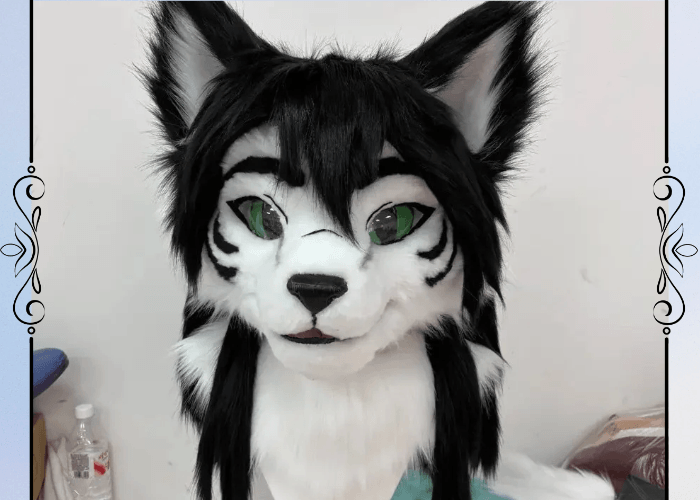
A wolf fursuit is the single most common custom fursuit species in the furry fandom. If you’re reading this, you probably already know what you want your wolf to look like. The question is how to get from a character concept to a real, wearable suit that fits your body, matches your reference sheet, and holds up through years of convention weekends.
We build custom wolf fursuits at Fursuit Mania in New York City. Wolves make up a large portion of our commission queue, and every one is different. Grey timber wolves with natural markings, neon blue wolves with galaxy patterns, Arctic wolves in all white with ice-blue eyes. The species is the same, but no two wolf suits we’ve built have looked alike.
This guide covers every decision you’ll face when commissioning a wolf fursuit: which style fits your character, what each option costs, how to prepare your reference sheet, and what the build process actually looks like from start to finish.
Why Wolf Fursuits Are the Most Popular Choice in the Fandom
Wolves have been the most popular single fursona species for over a decade. Research from the International Anthropomorphic Research Project (Furscience) consistently places wolves at the top, ahead of foxes and dragons. The blue wolf as a first fursona is so common it became a meme in the community.
Why wolves specifically? Part of it is the animal itself. Wolves are expressive. They have a long muzzle that gives a fursuit head a strong silhouette from every angle. Their ears are tall and readable from across a convention hall. Their fur comes in greys, browns, blacks, whites, and rust tones that mix well together, and that same natural color range gives makers a solid base to work from when someone wants a fantasy color scheme instead.
There’s also the personality association. Wolves carry a mix of independence and loyalty that resonates with a lot of people in the fandom. That’s part of why wolf fursonas tend to feel personal to their owners in a way that goes beyond the costume itself.
I’d say around 25% of my commissions are wolf characters. I’ve noticed people mostly like simple wolf designs with cool colors and a few custom markings. Fluffy ones and darker wolves seem to be pretty popular too.
Wolf Fursuit Styles: Toony, Realistic, Semi-Realistic, and Kemono
Wolf fursuits come in four main styles: toony, realistic, semi-realistic, and kemono. Toony wolves have exaggerated cartoon proportions with large round eyes, a shorter rounded muzzle, and bright expressive features. Realistic wolves aim for natural wolf anatomy with accurate muzzle taper, mixed fur pile lengths, and lifelike eyes. Semi-realistic splits the difference. Kemono wolves follow the Japanese anime-inspired aesthetic with oversized dome eyes and soft, rounded features.
Each style changes the entire character of the suit. A toony wolf is approachable, fun, great for high-energy convention interactions. Kids walk right up to them. A realistic wolf gets a different reaction entirely. People slow down, hold eye contact longer, photographers drop to one knee to get that straight-on stare.
How Wolf Anatomy Shapes Fursuit Design
What makes a wolf head look like a wolf instead of a husky or a generic dog comes down to a few specific features. The muzzle taper. Wolves have a longer, narrower muzzle than most dog breeds, with a slight bridge along the top. The cheeks are deeper. The eyes sit further forward, which gives them that focused, alert expression.
Getting that muzzle length right matters more than almost any other measurement. Half an inch too short and the head reads as a cute dog mascot. Too long and narrow, and it starts looking stiff. The ear placement is just as critical. Wolf ears sit higher on the skull and angle slightly outward compared to a husky’s upright ears.
At Fursuit Mania, we keep the head shape pretty clean and simple. We focus on getting the muzzle, cheeks, and forehead right first, then add the smaller details. We usually start with a basic foam base and shape it from there. For the muzzle, we try to keep it long enough to give the wolf a good shape without making it too big. The biggest mistake we see is making the muzzle too short or too round, which can make the wolf look more like a dog.
Fur selection for a wolf suit also needs more thought than most species. Wolves have a two-layer coat in nature: short dense underfur with longer guard hairs on top. Most makers replicate this by mixing fur pile lengths, using shorter fur on the muzzle and around the eyes so the sculpted structure shows through, and longer fur on the cheeks, neck, and back of the head for that natural volume.
Color blending matters too. A grey wolf isn’t just one shade of grey. There’s cream at the throat, darker grey along the spine, lighter silver at the cheeks, and often rust or brown behind the ears. Getting that gradation right is the difference between a wolf that looks alive under convention lighting and one that looks flat.
What Does a Wolf Fursuit Cost?
A custom wolf fursuit head starts at $1,300. A partial wolf suit (head, paws, and tail) starts at $2,000. A fullbody plantigrade wolf suit starts at $3,000, and a fullbody digitigrade wolf suit starts at $3,300. These are starting prices at Fursuit Mania. Complex markings, multiple fur colors, and added features like LED eyes or articulated ears push the price higher.
Those numbers are specific to our studio. Industry-wide, you’ll find wolf fursuit prices that range from $300 for a mass-produced premade head from overseas, up to $5,000 or more from high-demand makers with multi-year waitlists. The price difference comes down to materials, build quality, and how closely the finished suit matches your exact character design.
What drives the cost up on a wolf specifically? Wolves tend to have more complex color patterns than simpler species. A solid-color cat fursuit uses one or two furs. A natural grey wolf might need four or five different furs to get the color transitions right across the head alone. Each additional fur color means more cutting, more seaming, and more time shaving and blending at the seam lines.
Digitigrade legs are the other big cost factor. A lot of wolf owners want that backward-knee look that gives the suit a more animal-like stance. Digitigrade padding adds $300 over the plantigrade version because it requires shaped foam inserts, additional patterning, and extra fitting time to get the legs to look right while still being comfortable to walk in.
We offer payment plans for any wolf fursuit over $1,500. The deposit is 30% of the total price, and the minimum monthly payment is $250. That means a $2,000 partial breaks down to a $600 deposit and roughly $350 a month after that. You can see every price on our fursuit prices page.
Custom vs Premade Wolf Fursuits
A premade wolf fursuit is one that’s already been built and is ready to ship. You pick from what’s available. Premades are faster (often same-week shipping), cheaper ($200 to $800 for a partial from many sellers), and good enough for someone who wants to try fursuiting before committing to a custom build.
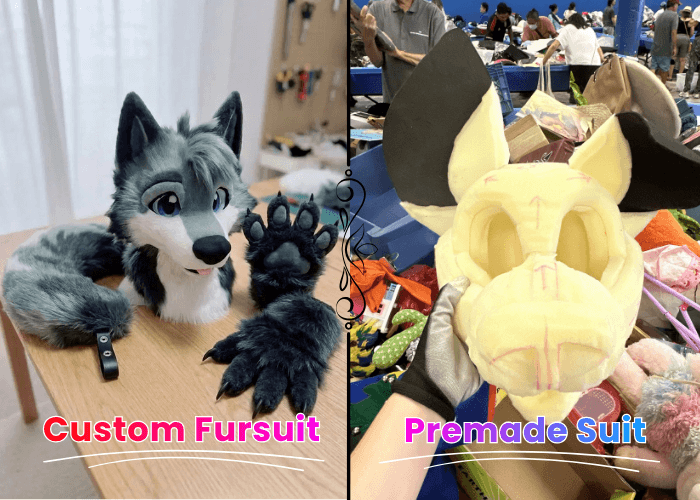
The trade-offs are real though. A premade won’t match your specific character. The head won’t be sculpted to your measurements. The expression, the eye color, the exact pattern of markings on the muzzle, those are whatever the maker decided when they built it. If your wolf fursona has a scar across the left eye and heterochromia, that’s not happening with a premade.
Custom is a different experience entirely. You send your reference sheet, you get a fixed price quote based on exactly what your character needs, and every piece is built from scratch to your body measurements. The head fits your head. The paws fit your hands. The markings match your character sheet.
For most people who are serious about their wolf fursona and plan to wear the suit at conventions, meetups, or for content creation, custom is worth the investment. The suit lasts longer because it’s built with better materials, it fits better because it’s measured to you, and it actually looks like your character instead of a close approximation.
If you’re on a tight budget and just want to see what fursuiting feels like before committing, a premade can be a fine first step. Just know that most people who start with a premade end up commissioning a custom suit within a year or two.
How to Commission a Custom Wolf Fursuit
The commission process at Fursuit Mania works like this.
First, you create or finalize your wolf reference sheet. This is the blueprint for your entire suit. We’ll cover what it needs to include in the next section.
Second, you submit your reference sheet through our quote form. You’ll tell us which type of suit you want (head only, partial, fullbody) and any special features. We look at your character’s complexity and give you a fixed price quote. No surprises, no hidden fees.
Third, once you approve the quote, you pay the 30% deposit. That locks in your spot in our build queue.
Fourth, we take your measurements. For a head, that’s your head circumference and a few facial measurements. For a fullbody suit, we need a full set of body measurements. We send you a measurement guide with instructions.
Then comes the build. It takes 3 to 4 months from the time we start working on your suit. Queue time before that varies depending on how many commissions are ahead of you. During the build, you get progress photos at key stages so you can see your wolf coming to life and flag anything that needs adjusting before it’s too late to change.
Once the suit is finished and you’ve made the final payment, we ship it to you. Start the process by sending your reference sheet through our quote form.
What to Include in Your Wolf Fursuit Reference Sheet
Your reference sheet is the single most important document in the entire commission process. A clear, detailed ref sheet means a suit that matches your character. A vague one means more back-and-forth, more guesswork, and a higher chance that something ends up different from what you imagined.
For a wolf character specifically, your ref sheet should show a front view and a side view of your character at minimum. A three-quarter angle helps too, especially for the head. Mark all color boundaries clearly. Wolves often have gradual color transitions (darker on top, lighter on the underside, rust tones behind the ears), and these transitions are hard to interpret if the ref sheet only shows solid blocks of color.
Include the eye color, the eye style (follow-me eyes, toony button eyes, realistic mesh eyes), and whether you want a static or moving jaw. Mark the ear shape (pointed, slightly rounded, one ear folded). Specify the tail length and how fluffy you want it. If your wolf has any unique features like piercings, scars, horns, or wings, draw them on the ref sheet and note them separately in text.
Don’t have a reference sheet yet? That’s common. Many fursuit commissioners hire a furry artist to create one. Budget $30 to $100 for a solid ref sheet from an experienced fandom artist. It’s the best $50 you’ll spend on the entire project. A good ref sheet saves time, prevents miscommunication, and gives your maker a clear target to build toward.
The thing I see most often with wolf ref sheets is not showing the side or back of the character clearly. It helps a lot when people include a full-body view, close-ups of the markings, and the colors they want us to use.
Wolf Fursuit Care and Maintenance Tips
Wolf fursuits need a bit more upkeep than darker, simpler suits. Light-colored fur (and wolves often have cream, white, or silver sections) shows dirt, makeup transfer, and staining faster than black or dark grey fur. If someone hugs you at a convention while wearing foundation, you’ll see it on a white wolf muzzle before you see it on a black cat suit.
Brush the fur regularly. Use a slicker brush for the longer fur on the head, chest, and tail, and a softer comb for the shorter fur around the eyes and muzzle. Always brush in the direction of the fur grain. Going against it puffs the fibers and makes the fur look matted and unnatural.
After every convention outing, spray the inside of the head with isopropyl alcohol (70%) and let it air dry completely before storing it. Sweat and moisture build up fast inside a fursuit head, and if you pack it away damp, it will smell bad by the next time you wear it.
Store the head on a head stand or in a rigid container with the ears supported. Wolf ears are tall and narrow. If they get crushed in a suitcase, they crease. That crease is hard to fix once it sets. Some people stuff the head with tissue paper for travel and brace the ears with cardboard inserts. It takes an extra five minutes to pack, but it saves you from a sad floppy ear at your next con.
Frequently Asked Questions About Wolf Fursuits
How much does a wolf fursuit cost?
A custom wolf fursuit head starts at $1,300. A wolf partial (head, paws, tail) starts at $2,000. A fullbody wolf suit starts at $3,000 for plantigrade and $3,300 for digitigrade. Complex color patterns, LED eyes, and moving jaw features add to the base price. Payment plans are available for orders over $1,500.
Are wolf fursuits the most common type?
Yes. Wolves are the most popular single fursona species in the furry fandom according to research from the International Anthropomorphic Research Project. This means wolf fursuits are among the most frequently commissioned species at most fursuit studios, including ours.
What is the difference between a toony and realistic wolf fursuit?
A toony wolf fursuit has exaggerated cartoon features: large round eyes, a shorter rounded muzzle, and vibrant colors. A realistic wolf fursuit aims for natural wolf anatomy with accurate muzzle proportions, lifelike eyes (often printed mesh), and mixed fur pile lengths that replicate a real wolf’s coat. Semi-realistic falls between the two.
How long does it take to build a custom wolf fursuit?
Build time at Fursuit Mania is 3 to 4 months from the start of construction. Queue wait time before the build begins depends on current demand. You receive progress photos during the build so you can see your wolf suit taking shape and request adjustments.
Can I get a wolf fursuit with a moving jaw?
Yes. Most custom wolf fursuit heads include a moving jaw as a standard feature. The jaw is attached with a hinge or spring mechanism so it opens and closes when you move your own jaw. This adds a lot of life and expression to the head, especially for wolf characters with that open-mouth, alert look.
What should my wolf reference sheet include?
A wolf fursuit reference sheet should include front and side views of your character with all color markings clearly labeled. Include eye color and style, ear shape, tail length, jaw type (moving or static), and any unique features like scars, horns, or accessories. Clear color boundary lines are especially important for wolves because they often have gradual color transitions.
Do you offer payment plans for wolf fursuits?
Yes. Fursuit Mania offers payment plans for any order over $1,500. The deposit is 30% of the total price (non-refundable), and the minimum monthly payment is $250. Your suit ships after the balance is paid in full.
Ready to Bring Your Wolf Character to Life?
If you’ve got a wolf fursona and you’re ready to make it real, the next step is simple. Send your reference sheet through our quote form and we’ll give you a fixed price based on exactly what your character needs. No commitment, no pressure. Just a clear number so you can plan.
Every wolf suit we build at Fursuit Mania is made from scratch to your measurements using premium faux fur, hand-carved foam or 3D printed resin bases, high-vision mesh eyes, and silicone paw pads. We’re based in New York City and we’ve been building custom fursuits since 2022.
Send your wolf reference sheet through the free quote form and get your price.